Section 7.8 · Further exercises · 5 of 10
Exercise 7.8.5: Over- or undercoupled? A one-port cavity
About the further exercises of Section 7.8
Ten further exercises in the spirit of Problems 7.8.1–7.8.5 and the home exercises, graded from easy to harder. Exercises 7.8.1–7.8.6 are about cavity resonators, Exercises 7.8.7–7.8.10 about microwave devices and scattering parameters. They use only the results of this section, in particular , of Eq. (7.8.24) with ( for a cube), of Eq. (7.8.33), , , , the response with , and for S-parameters , reciprocity , losslessness , and .
Over- or undercoupled? A one-port cavity
#A copper TE cavity is made from WR-90 (, ), closed by a wall and by an iris through which it is fed. Its resonance is at . At the reflection dips to , and the power absorbed by the cavity has a half-power width of . (a) Find the length and the theoretical of the copper walls. (b) Find and the two possible values of . (c) Which one is right? Give and . (d) What fraction of the incident power is absorbed at ? (e) The iris is enlarged for critical coupling. Find , and the new bandwidth.
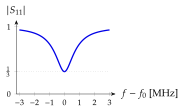
At the cavity terminates the line in the normalised conductance , so , and the loaded is . The magnitude cannot tell from , but the theoretical of the walls can: no real cavity beats it.
At and . With , Eq. (7.8.24) gives .
. gives (overcoupled) or (undercoupled).
would mean , times the theoretical copper value, which is impossible. Hence , and
is absorbed in the walls.
Critical coupling: , , , , and all the incident power is absorbed at .
. Detuned, with (plotted), whose magnitude is the same for and , and the half-power point of the absorbed power lies at .
On a vector network analyser the two cases are told apart at once: as sweeps through , traces a circle that encloses the centre of the Smith chart when the cavity is overcoupled and passes beside it when it is undercoupled. Here the plotted magnitude gives the same curve for and , and the physics of the walls decides.
cf. Problem 7.8.4