Section 7.8 · Further exercises · 6 of 10
Exercise 7.8.6: The cavity as a parallel RLC circuit
About the further exercises of Section 7.8
Ten further exercises in the spirit of Problems 7.8.1–7.8.5 and the home exercises, graded from easy to harder. Exercises 7.8.1–7.8.6 are about cavity resonators, Exercises 7.8.7–7.8.10 about microwave devices and scattering parameters. They use only the results of this section, in particular , of Eq. (7.8.24) with ( for a cube), of Eq. (7.8.33), , , , the response with , and for S-parameters , reciprocity , losslessness , and .
The cavity as a parallel circuit
#Describe the TE mode of the copper cavity of Problem 7.8.2 (, , , at ) by a parallel circuit whose voltage is along the centre line. (a) Find , and from and . (b) Check and find . (c) Compare with a parallel-plate capacitor with gap . (d) What voltage does sustain?
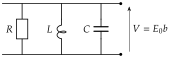
At resonance the circuit stores and loses in (the box of Section 7.8.8). Matching both to the field values defines and , and gives . The values depend on where is defined, but depends on the geometry only.
With and ,
, the of Problem 7.8.2. .
The plate capacitor would have , four times more. The factor comes from the averages of and : the field, and so the charge, is concentrated in the middle of the plates.
, that is , as in Problem 7.8.2(e).
.
A capacitor and a inductor could be built as lumped parts, but their would be near , because thin wires carry the current. In the cavity the "inductor" is the whole wall area and the current spreads over it. is the figure of merit of accelerating cavities: for a given stored energy it measures how much voltage the cavity offers the beam, and it does not depend on the wall material.
cf. Problem 7.8.2