Section 7.8 · Further exercises · 7 of 10
Exercise 7.8.7: Two three-ports
About the further exercises of Section 7.8
Ten further exercises in the spirit of Problems 7.8.1–7.8.5 and the home exercises, graded from easy to harder. Exercises 7.8.1–7.8.6 are about cavity resonators, Exercises 7.8.7–7.8.10 about microwave devices and scattering parameters. They use only the results of this section, in particular , of Eq. (7.8.24) with ( for a cube), of Eq. (7.8.33), , , , the response with , and for S-parameters , reciprocity , losslessness , and .
Two three-ports
#Two three-port components have
(a) Test each for reciprocity, losslessness and match. (b) enters port 1 with ports 2 and 3 matched. Where does it go? Give the return and insertion losses. (c) Show that no lossless reciprocal three-port can be matched at all three ports. (d) Suggest a physical realisation of each.
Reciprocity: symmetric. Losslessness: every column has unit length and different columns are orthogonal. Match: zero diagonal. With port 1 driven, the powers leaving the ports are , and (in watts per watt), and the rest is absorbed.
Both matrices are symmetric: reciprocal. : each column has , and, for example, columns 1 and 2 give : lossless, but not matched (). : matched (), but each column has squared length : lossy.
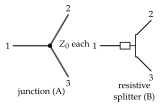
A: reflected (), to each of ports 2 and 3 (), nothing absorbed. B: nothing reflected, to each output (), and absorbed in the resistors.
Let and . Unit columns give , and , so all three equal . Orthogonality of columns 1 and 2 requires , so or vanishes, a contradiction. A lossless matched three-port must be non-reciprocal (the circulator) or contain loss (splitter B).
A is three equal lines joined at one point. A wave on line 1 meets the two others in parallel, , so and the voltage continues on each. B is the three-resistor splitter with in each arm.
Splitter B: port 1 sees , matched. Each output receives of the input voltage, a quarter of the power.
The theorem of (c) is why a waveguide T-junction can never be matched at all its arms, why splitters with isolated outputs need a resistor (the Wilkinson divider) and why the circulator, matched and lossless, must use a magnetised ferrite.
cf. Home exercise 7.8.4