Section 7.8 · Further exercises · 8 of 10
Exercise 7.8.8: A magic tee in a monopulse radar
About the further exercises of Section 7.8
Ten further exercises in the spirit of Problems 7.8.1–7.8.5 and the home exercises, graded from easy to harder. Exercises 7.8.1–7.8.6 are about cavity resonators, Exercises 7.8.7–7.8.10 about microwave devices and scattering parameters. They use only the results of this section, in particular , of Eq. (7.8.24) with ( for a cube), of Eq. (7.8.33), , , , the response with , and for S-parameters , reciprocity , losslessness , and .
A magic tee in a monopulse radar
#An ideal magic tee has the collinear ports 1 and 2, the H-arm 3 (sum) and the E-arm 4 (difference):
(a) Show that it is lossless, reciprocal and matched. (b) Two antennas apart feed ports 1 and 2 with equal amplitudes ( each) and a phase difference . Find and . (c) At a target is off boresight. Find , , and in dB. (d) At what angle is the difference below the sum? How does the radar tell left from right?
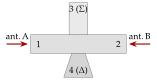
With ports 3 and 4 matched () the outputs are and : the tee forms the sum and the difference of the two antenna signals. A plane wave from the angle reaches the second antenna with the extra path .
is symmetric (reciprocal), its diagonal is zero (matched), each column has two entries of magnitude (unit length), and, for example, columns 3 and 4 give : lossless.
With , and (here the convention ),
. Then , and , that is .
gives and , so . The sign of (the phase of the difference relative to the sum) changes when the target crosses boresight: a phase detector comparing with gives the side.
, the total input: the lossless tee only redistributes the power. On boresight () all of it goes to the sum port and .
The difference channel has a sharp null on boresight, far sharper than the maximum of the sum beam. A tracking radar steers its antenna to keep at zero and reaches a small fraction of the beamwidth in angle accuracy with a single pulse, hence "monopulse". The same tee, fed from port 3 or 4, splits a signal into two equal halves in phase or in antiphase.
cf. Problem 7.8.5