Section 7.8 · Further exercises · 9 of 10
Exercise 7.8.9: How wide is a coupler's directivity?
About the further exercises of Section 7.8
Ten further exercises in the spirit of Problems 7.8.1–7.8.5 and the home exercises, graded from easy to harder. Exercises 7.8.1–7.8.6 are about cavity resonators, Exercises 7.8.7–7.8.10 about microwave devices and scattering parameters. They use only the results of this section, in particular , of Eq. (7.8.24) with ( for a cube), of Eq. (7.8.33), , , , the response with , and for S-parameters , reciprocity , losslessness , and .
How wide is a coupler's directivity?
#A coupler between two identical WR-90 guides (, TE) is designed for with holes spaced . (a) Find . (b) Two equal holes, each coupling the amplitude (): find the coupling and the directivity at , , and (neglect the frequency dependence of the holes). (c) Three holes with amplitudes : show that and repeat. (d) Over which band is for each design?
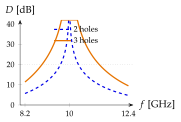
Hole (at ) sends a wave forwards and a wave backwards in the upper guide. All forward contributions travel the same total path and add in phase, . The backward one from hole has travelled further: . With , and .
, and .
, so at all frequencies. , with :
| [GHz] | [deg] | [dB], two / three holes | |
|---|---|---|---|
| / | |||
| / | |||
| / | |||
| / | |||
| / |
With , and , so while ( again). Hence , and doubles in dB (last column of the table).
Two holes: for , that is to (). Three holes: for , that is to ().
The rule of thumb of Section 7.8.16, off by gives : at , and , and at , .
Binomial weights put an -fold zero of the backward sum at the design frequency, which flattens the directivity around it. Commercial broadband couplers use ten or more holes, often with Chebyshev weights, and reach over a whole waveguide band.
cf. Problem 7.8.5