Section 7.8 · Further exercises · 10 of 10
Exercise 7.8.10: Hiding a bad antenna behind a pad or an isolator
About the further exercises of Section 7.8
Ten further exercises in the spirit of Problems 7.8.1–7.8.5 and the home exercises, graded from easy to harder. Exercises 7.8.1–7.8.6 are about cavity resonators, Exercises 7.8.7–7.8.10 about microwave devices and scattering parameters. They use only the results of this section, in particular , of Eq. (7.8.24) with ( for a cube), of Eq. (7.8.33), , , , the response with , and for S-parameters , reciprocity , losslessness , and .
Hiding a bad antenna behind a pad or an isolator
#A source with a matched output ( available) feeds an antenna with VSWR . (a) Show that a two-port terminated in has and that the load receives watts. (b) A matched attenuator is inserted. Find , the VSWR and the power radiated. (c) Instead, an isolator with insertion loss, isolation and is used. Find the range of and of the radiated power. (d) Compare with no insertion at all.
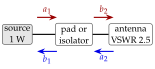
The load closes the loop: what leaves port 2 comes back as . Eliminating and from the two S-equations gives the input reflection. A matched source sends whatever the load, and the load keeps .
gives , and then gives the stated . The delivered power is with .
. The pad has , :
and . The second term has the magnitude
and adding with unknown phases,
Without anything: (VSWR , ) and .
Pad: the reflected wave passes it twice, , and . The source power balances: absorbed in the pad ( on the way in, on the way back).
Both tricks hide the mismatch from the source, but they are not equal. The pad buys a good match by throwing away of the power, acceptable in a measurement set-up but not in a transmitter. The isolator buys almost the same match for , because it absorbs only the reflected wave. With it would give exactly : the residual reflection is set by the isolation.
cf. Home exercise 7.8.4