Section 7.8 · Worked examples · 1 of 3
Worked example 7.8.1: The modes of a microwave oven
Three short calculations tied to the applications, with resonant frequencies, , bandwidth, stored energy and wall loss. They use only the results of this section. A good way to use them: read the given quantities, produce the formula from the corresponding application yourself, and only then put the numbers in. Constants: , , , copper , , .
The modes of a microwave oven
#cf. Application 7.8.1
Given. An oven cavity wide (), high (), deep (), fed at . With food inside the loaded is about .
Find. (a) and the lowest resonance of the box, (b) the resonances between and , compared with the estimate , (c) the hot spots of TE on the floor, (d) how many modes the magnetron drives at once.
, Eq. (7.8.28). A large box has a dense spectrum: the estimate counts the modes per band (both polarisations), and the loaded bandwidth tells how many of them are excited together.
. is the smallest side, so the lowest mode is TE: . At the box measures .
A search over gives, in GHz,
six modes in . With ,
TE has (: uniform in height). Its maxima lie apart across and apart in depth: hot spots with cold lines between them (Figure 7.8.10b).
, that is around . TE, TE, TM and TM lie inside, TM ( below) and TE ( above) at the edges: four to six modes at once (Figure 7.8.27).
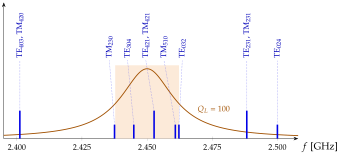
Over to the estimate gives , and the search finds (counting TE, which falls exactly on ), with the mean spacing .
The food sees a sum of several standing waves, each with its own hot spots. Their spacing ( and here) is never smaller than , because each of the three wave-number components is at most . The turntable moves the food through the pattern, and the mode stirrer shifts the resonances so that the pattern itself moves.