Section 7.4 · Home exercises · 3 of 3
Home exercise 7.4.3: When does TE_{01} win?
When does TE win?
#The copper circular waveguide of Problem 7.4.2 ( cm, air, S/m) can carry TE or TE.
- Write of both modes and show that their ratio does not depend on .
- Find (numerically) the frequency above which TE has the lower loss, and the loss there.
- Compare the two losses at GHz.
- Give one reason why TE is nevertheless hard to use in this guide.
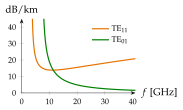
Both formulas carry the common factor , which cancels in the ratio. The crossing then depends only on and is found by evaluating the ratio at a few frequencies and interpolating.
With GHz, GHz, and :
where . and cancel: the crossing does not depend on the metal.
The ratio is at GHz, at GHz and at GHz. The crossing lies at GHz , where both modes lose dB/km ( m there).
At GHz, m and Np/m. TE: Np/m dB/km. TE: dB/km, times more.
TE is not the lowest mode. At GHz the pipe carries field patterns, and bends convert TE into TE, TM, TE and especially into the degenerate TM, which has exactly the same phase velocity.
At GHz the ratio agrees with Problem 7.4.2. The crossing is marked by the meeting of the two curves in the figure of the statement.
The long-haul systems of Application 7.4.2 lined the pipe with insulated helical wire: it carries the purely azimuthal wall current of TE but blocks the axial currents of the unwanted modes, which are then absorbed in the lossy jacket behind the helix.