Section 7.4 · Further exercises · 1 of 5
Exercise 7.4.1: Reading a mode from its field
Five further exercises on the circular guide, in the spirit of Problems 7.4.1–7.4.2, the worked examples and the home exercises, graded from easy to harder. They use only the results listed at the head of this subsection. (Five more, on the coaxial line, close Section 7.5.)
Reading a mode from its field
#In an air-filled circular waveguide the longitudinal electric field is
and the wall is the first zero of away from the axis. (a) Is the mode TE or TM? Give and . (b) Find the radius . (c) Find the frequency, the cutoff frequency, and . (d) Find (or ) and write and . (e) Which other modes propagate at this frequency, and how many field patterns does the guide carry in all?
A nonzero means TM. The order of the Bessel function and of gives , the number of zeros along a radius gives . The two numbers in the formula are rad/m and rad/m, and fixes the frequency.
: a TM mode. and : . The wall is the first zero of away from the axis: . The mode is TM, in its version.
, so mm.
rad/m and
and . From Eq. (7.4.13) with , , so
A mode propagates if its zero is below : TE (), TM (), TE (), TE and TM (), TE (). TM () is cut off. Six modes. TM and TE have one pattern each, the other four two: field patterns.
from its own formula in Eq. (7.4.17): . And gives .
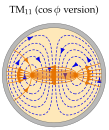
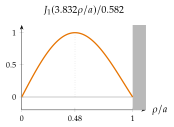
TM shares its cutoff with TE because . A guide that is meant to carry the low-loss TE therefore always offers TM as a partner with exactly the same phase velocity, into which bends convert power without any phase mismatch to stop it (Figure 7.4.12).
cf. Problem 7.4.1