Section 7.4 · Further exercises · 2 of 5
Exercise 7.4.2: The frequency of least loss
About the further exercises of Section 7.4
Five further exercises on the circular guide, in the spirit of Problems 7.4.1–7.4.2, the worked examples and the home exercises, graded from easy to harder. They use only the results listed at the head of this subsection. (Five more, on the coaxial line, close Section 7.5.)
The frequency of least loss
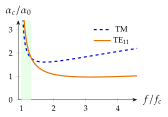
#Section 7.4.9 says that the conductor loss of TM has a minimum at , and that TE has one too.
- Prove the result for any TM mode of a circular guide.
- Show numerically that the TE minimum lies near .
- For an air-filled copper pipe with cm find both minima (frequency and dB/km).
- How many field patterns propagate at those two frequencies? What does this mean for a single-mode TE link in this pipe?
Write . Since , , and each attenuation constant becomes times a function of alone, with . Minimise that function.
For TM modes . Its square is , and
The minimum is , for every TM (only differs).
For TE, with . Values: , , . The minimum lies between and , close to , and refining gives , .
GHz: GHz, GHz.
At GHz, : TE, TM, TE, TE and TM, that is field patterns. At GHz, : ten modes up to TM (), field patterns. Single-mode TE operation is limited to – GHz, where is still falling steeply: dB/km at ( GHz).
Through , taken at the cutoff of each mode: TE has m, Np/m and Np/m dB/km. TM has m, Np/m and Np/m. Both agree with part (c).
The minima of TE and TM are real but useless for a single-mode guide: they lie far above the next cutoffs. In the usable band, to , the loss falls with frequency, so a designer picks the largest radius that still keeps TM out. Only the circularly symmetric TE modes, TE first, have no minimum at all (Problem 7.4.2).
cf. Problem 7.4.2