Section 7.4 · Further exercises · 3 of 5
Exercise 7.4.3: A quarter-wave circular polariser
About the further exercises of Section 7.4
Five further exercises on the circular guide, in the spirit of Problems 7.4.1–7.4.2, the worked examples and the home exercises, graded from easy to harder. They use only the results listed at the head of this subsection. (Five more, on the coaxial line, close Section 7.5.)
A quarter-wave circular polariser
#A round air-filled pipe has been squeezed very slightly. Its two TE polarisations no longer share a cutoff: the one with along starts at GHz, the one with along at GHz. A linearly polarised TE wave at between and enters at .
- Find and at GHz.
- Find the length that makes the output circularly polarised. Which hand?
- Find the phase difference and the axial ratio (in dB) at and GHz.
- Is the section single-mode over – GHz?
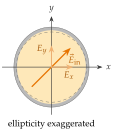
The input splits into equal and components, each travelling as its own TE mode with its own . After a length the component lags by . A lag of with equal amplitudes is circular polarisation (Section 6.1). For a phase difference between equal components the polarisation ellipse has the axial ratio .
rad/m at GHz:
gives cm. At the output, dropping the common phase, , that is : the field turns from to . With the thumb along the fingers of the right hand would turn from to , so the wave is left-handed (LHCP) in the convention of Section 6.1. An input at gives RHCP.
With the same :
| [GHz] | , [rad/m] | AR | |
|---|---|---|---|
| , | ( dB) | ||
| , | ( dB) | ||
| , | ( dB) |
The radii that go with the two cutoffs are and mm, and TM starts at , between and GHz: the section is single-mode up to GHz.
At the centre frequency . Near cutoff changes fastest with frequency, so the error is larger at the low edge () than at the high edge (), as Figure 7.4.13 shows.
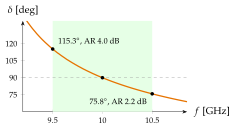
The polarisation has the lower cutoff because the pipe is now slightly taller along : like TE of a rectangular guide, TE with its central along varies across , so the dimension sets its cutoff. The squeeze is only in radius, yet cm suffices because both modes run close to cutoff, where a small change of moves a lot. The price is the narrow band: a band already costs dB of axial ratio. Practical polarisers use dielectric vanes or rows of screws and work further above cutoff to flatten . The same physics, uncontrolled, is the polarisation drift of long round pipes noted in Section 7.4.8.
cf. Worked example 7.4.1