Section 7.4 · Further exercises · 4 of 5
Exercise 7.4.4: Wall currents and slots
About the further exercises of Section 7.4
Five further exercises on the circular guide, in the spirit of Problems 7.4.1–7.4.2, the worked examples and the home exercises, graded from easy to harder. They use only the results listed at the head of this subsection. (Five more, on the coaxial line, close Section 7.5.)
Wall currents and slots
#An air-filled circular guide with cm carries the TE mode at GHz.
- Find the surface current on the wall and the ratio of the largest axial to the largest azimuthal current.
- A narrow slot cut along (axial) or around the pipe (circumferential) does not disturb the mode if no current crosses it. Where can each be cut?
- A probe for a slotted measuring section is pushed through an axial slot. Where does it see the strongest field, relative to the field on the axis?
- Repeat (b) for TE and TM. Why does a TM rotary joint need a choke?
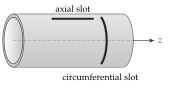
On a perfect conductor , with the normal pointing from the wall into the guide. Only the tangential and at matter. A slot is harmless when it runs parallel to the current.
At , with : and, from Eq. (7.4.20), . Then
GHz, , rad/m, rad/m:
An axial slot at is crossed only by : it is harmless at and , the top and the bottom, where the central meets the wall. A circumferential slot at is crossed by : a short one is harmless at and , the sides. A full ring cuts somewhere and always radiates.
The probe couples to the normal field , largest at , exactly where the axial slot is harmless. On the axis (Section 7.4.8), so the wall field is
of the central field.
TE: and is uniform around the wall, so runs only around the pipe. Circumferential slots, even full rings, are harmless anywhere, axial slots radiate everywhere. TM: and is uniform, so is purely axial. Axial slots are harmless, circumferential ones are not. The rotating gap of a rotary joint is a full circumferential slot across the TM current. A quarter-wave choke presents a short circuit at the gap without metal contact and lets the axial current pass.
Charge conservation on the wall, with (the normal points along ). With and the factor :
The two sides agree. The charges sit at the top and the bottom, where ends on the wall.
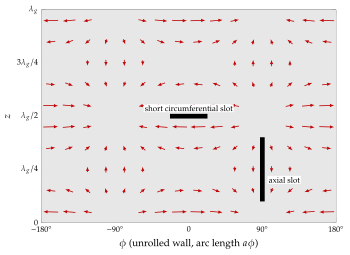
The helix lining of the TE trunk lines (Application 7.4.2) is this argument made into hardware: closely wound insulated wire is a wall of circumferential conductors with axial gaps everywhere. TE does not notice, while every mode that needs an axial current sees an open wall and loses its power into the absorbing jacket. The slotted line in part (c) is the circular version of the classic slotted rectangular guide, whose slot runs along the middle of the broad wall for the same reason.
cf. Application 7.4.1