Section 7.4 · Further exercises · 5 of 5
Exercise 7.4.5: Peak power and loss of a TM_{01} rotary joint
About the further exercises of Section 7.4
Five further exercises on the circular guide, in the spirit of Problems 7.4.1–7.4.2, the worked examples and the home exercises, graded from easy to harder. They use only the results listed at the head of this subsection. (Five more, on the coaxial line, close Section 7.5.)
Peak power and loss of a TM rotary joint
#An S-band surveillance radar ( GHz) uses an air-filled copper TM rotary joint of radius cm. Use , , and the maximum of , at .
- Check that only TE and TM propagate.
- With , find , and the power in terms of .
- Where is largest? Find the peak power for MV/m, and with a safety factor on the field.
- From the wall current find , and compare with Eq. (7.4.23).
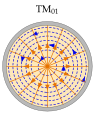
For the TM formulas leave , and , all built from and . The power is the integral of over the disc, which the given Bessel integral evaluates. The loss is with .
GHz: TE GHz, TM GHz, TE GHz. At GHz only TE and TM propagate.
rad/m, rad/m, , , rad/m. From Eq. (7.4.17) with :
with . Then and, with ,
and are in time quadrature, so at each point the field vector traces an ellipse whose longer half-axis is the larger of and . (on the axis), while . The largest field is , on the axis:
On the wall and , so
the formula Eq. (7.4.23). m at GHz: Np/m dB/m.
. A numerical integration of over the disc gives the same W.
A megawatt pulse needs only MV/m on the axis. Unlike the coaxial line, whose field crowds onto the inner conductor (Section 7.5), TM concentrates its field in the middle of the pipe, away from the metal, which is one reason high-power joints use it. Arcing in practice starts at the edges of the coupling probes and of the choke gap, so real ratings are set lower and the joints are often pressurised.
cf. Worked example 7.4.2