Section 7.4 · Worked examples · 1 of 2
Worked example 7.4.1: The circular feed of a Ku-band satellite receiver
Two short calculations tied to the applications and to the polarisations of TE. They use only the cutoff conditions of the circular guide and the universal formulas Eq. (7.4.3). Constants: m/s, , copper S/m. A good way to use them: read the given quantities, pick the formula yourself, and only then put the numbers in.
The circular feed of a Ku-band satellite receiver
#Given. A satellite-TV receiver (LNB) takes both linear polarisations of the – GHz band from the dish through a short air-filled circular waveguide, where a vertical and a horizontal probe pick up the two signals.
Find. (a) The radii for which TE alone propagates over the whole band. (b) For mm: the cutoffs of TE, TM and the margins. (c) , , at , and GHz. (d) Why do the two probes not disturb each other?
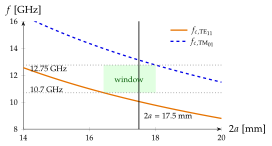
TE must be above its cutoff at the lowest frequency of the band, and TM, the next mode, below its cutoff at the highest:
TE on at GHz: mm. TM off at GHz: mm. So mm. The window is narrow because the band ratio uses most of the single-mode ratio (Figure 7.4.15).
mm: GHz and GHz. The band edges lie at and : margins of and .
With , , , :
| [GHz] | |||
|---|---|---|---|
| [mm] | |||
| [] |
The and versions of TE are orthogonal (Figure 7.4.6): the vertical probe couples only to the mode whose central field is vertical, the horizontal probe only to the other. The two signals share the pipe without interfering.
At GHz, mm and mm. in every column.
At the low band edge the guide works at only : is almost three times and changes fast with frequency, so the transitions to the probes need careful matching. A slightly elliptical pipe would give the two polarisations different cutoffs and let them exchange power along the guide (Exercise 7.4.3), which is why the feed is kept short and round.
cf. the TE polarisations