Section 7.5 · Topic 1 of 8
7.5.1 The TEM wave of the coaxial line
A TEM wave has . Write its fields as , , with and in the cross-section. Split the nabla operator into and apply Maxwell's equations in the source-free filling.
Faraday's law. has two parts. The part along is , so
The transverse part comes from the derivative alone: , that is
Ampère's law. gives in the same way . Inserting Eq. (7.5.2) and using ,
The TEM wave travels with , the wavenumber of a plane wave in the filling: , no cutoff, , no dispersion. With , Eq. (7.5.2) becomes , exactly as for a plane wave.
Gauss's law. .
A field with zero curl, Eq. (7.5.1), is the gradient of a potential, , and zero divergence then gives
the transverse field of a TEM wave is the electrostatic field of the two conductors, solved in the cross-section. This is why a TEM wave needs two conductors (Section 7.4): with one conductor the only solution of Eq. (7.5.3) is a constant.
The coaxial field. By symmetry , and Laplace's equation in polar coordinates reads
With the inner conductor at and the outer one at ,
with and of the filling, for .
Take the static field of a cylindrical capacitor and the static field of a straight current, put them together in the same cross-section, and let the whole pattern slide along the line at the speed of light in the dielectric. Both fields fall as : they are strongest at the inner conductor.
Watch the radial and the circular of the precision air line of Problem 7.5.1 () travel down the line below, then change and see follow .
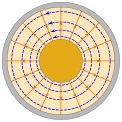
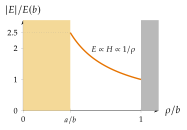
The transverse pattern Eq. (7.5.5) does not depend on the frequency. At dc it is the electrostatic field of Section 3.2 and the magnetostatic field of Chapter 4, at GHz it is the same picture travelling at . This is what makes the coaxial line a broadband medium: from dc up to the first higher-order cutoff (Section 7.5.6), a pulse of any shape passes undistorted, apart from the losses.