Section 7.5 · Topic 2 of 8
7.5.2 Voltage, current and characteristic impedance
Because the transverse electric field has zero curl, the line integral of between the conductors in one cross-section does not depend on the path, and the voltage is well defined:
The current follows from Ampère's law around the inner conductor (Section 4.1): the circle of radius encloses the current of the inner conductor, and
independent of , as it must be. The outer conductor carries on its inner surface.
is the ratio of voltage to current of a wave travelling one way. It is set by the filling () and by the geometry through the logarithm of only: scaling the whole cable up or down does not change .
is the capacitance per unit length of the cylindrical capacitor, Eq. (3.4.29) in Section 3.4, and is the external inductance per unit length of the coaxial cable (Home exercise 4.2.1 in Section 4.2). Two checks connect the field picture with circuit theory:
The transmission-line model with and is exact for the TEM wave: the line equations of circuit theory and Maxwell's equations give the same voltage, current and speed.
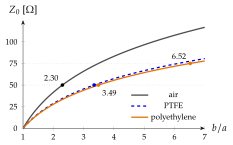
Figure 7.5.3 shows against . A line needs in air, with polyethylene and with PTFE. in polyethylene needs . Because depends only logarithmically on , a wide range of impedances is impractical: in air needs , a gap of a few per cent of the radius, and needs , a very thin inner conductor.
An RG-58 type cable has mm and a polyethylene dielectric of diameter mm. Find and the velocity factor .
and , nominally a cable. : a signal needs ns per metre.