Section 7.5 · Further exercises · 2 of 5
Exercise 7.5.2: A support bead in a precision air line
About the further exercises of Section 7.5
Five further exercises on the coaxial line, in the spirit of Problems 7.5.1–7.5.3, the worked example and the home exercise, graded from easy to harder. They use only the results listed at the head of this subsection. (Five more, on the circular guide, close Section 7.4.)
A support bead in a precision air line
#The inner conductor of a air line ( mm, mm) is held by short PTFE beads () that fill the whole gap.
- Find inside a bead if nothing else changes, and the reflection coefficient of a TEM wave at the air–bead interface.
- To keep the inner conductor is undercut inside the bead. Find its diameter .
- Estimate the TE cutoff in the air line, in the uncompensated bead and in the compensated bead.
- Comment on the frequency rating of the line.
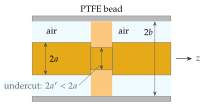
The TEM field pattern does not depend on the filling, so at the face of the bead the wave meets a change of only: this is normal incidence on a dielectric boundary (Section 6.3), and the reflection coefficient is .
. In the bead and
so of the power is reflected (return loss dB).
, , mm (from mm).
:
Between about and GHz a TE field can exist inside the bead but not in the air on either side. It is trapped in the bead and can resonate there, producing sharp dips in the transmission. Precision mm lines are therefore rated to GHz, below the air-line cutoff, and their beads are kept short so that the trapped-mode resonances lie above the rated band.
. The exact TE roots are , and GHz, to above the estimates.
A mm bead at GHz is electrically tiny, and the uncompensated reflection would partly cancel between its two faces. At GHz the bead is of a wavelength in PTFE and the two reflections no longer cancel: compensation is essential in every precision connector. The undercut changes the field near the step slightly, and connector designers fine-tune it with small chamfers.
cf. Application 7.5.1