Section 7.5 · Further exercises · 3 of 5
Exercise 7.5.3: Where the power flows and how fast the energy moves
About the further exercises of Section 7.5
Five further exercises on the coaxial line, in the spirit of Problems 7.5.1–7.5.3, the worked example and the home exercise, graded from easy to harder. They use only the results listed at the head of this subsection. (Five more, on the circular guide, close Section 7.4.)
Where the power flows and how fast the energy moves
#The cable of Exercise 7.5.1 ( mm, , polyethylene ) carries a TEM wave with V.
- Find the fraction of the power flowing within . Which radius divides the power into halves? What fraction flows in the inner half of the gap?
- Find the time-average electric and magnetic energies per unit length, and , from the fields.
- Find the energy velocity .
- Compare the energy densities at and .
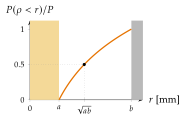
, while the area of a ring grows as : each ring carries a power , so the power inside grows as . The energies are integrals of and over the annulus.
Half the power flows inside mm, the geometric mean of the radii. The inner half of the gap, mm, carries .
With :
since . The two energies are equal, as in a plane wave.
W, so
In symbols , independent of the radii.
Both energy densities fall as : at they are times larger than at .
nJ/m and nJ/m with A: the circuit picture holds exactly for the TEM wave.
The power crowds towards the inner conductor: almost two thirds flow in the inner half of the gap, and the fields there are also strongest. This is why the inner conductor dominates both the copper loss and the breakdown, and why a dielectric defect near the centre conductor matters more than one near the braid. The energy velocity equals the group velocity of the dispersionless TEM wave.
cf. Problem 7.5.1