Section 7.5 · Home exercises · 1 of 1
Home exercise 7.5.1: A 75\ \Omega foam-dielectric cable
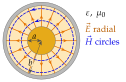
A foam-dielectric cable
#A television cable uses a gas-injected foam polyethylene with and an inner conductor of diameter mm.
- Find the inner diameter of the outer conductor.
- Find , and the velocity factor .
- Estimate the highest frequency of single-mode operation.
- Why does foam lower the loss compared with solid polyethylene of the same and ?
Invert . For part (d) compare the two cables at fixed and : then is the same for both, and depends only on how thick the inner conductor may be.
, so mm.
(exact root: GHz).
Solid polyethylene () with the same needs , a thinner inner conductor, mm for the same . Then is instead of m, so the foam cable has less conductor loss. Its dielectric loss is also smaller, by , for the same .
and m/s .
Foam is mostly gas: a lower raises , so the target impedance is reached with a smaller , that is a thicker inner conductor, which carries the current on a larger surface. This is why low-loss television and satellite cables use foam, and why the best lines use air with a few supports (Exercise 7.5.2).