Section 7.6 · Problems · 3 of 4
Problem 7.6.3: A single-mode fibre
A single-mode fibre
#A step-index silica fibre: core , cladding , core radius , cladding diameter .
- Find NA, the acceptance angle (launch from air) and the critical angle at the core–cladding boundary.
- Find at and . Single-mode? Largest single-mode core radius at ?
- Find the cutoff wavelength. Which LP modes propagate at ?
- At solve for LP: and the core power fraction. Is the cladding thick enough?
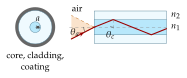
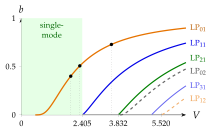
NA and the two angles are plane-wave optics (Section 6.4). The mode content depends on alone: LP starts at the first zero of , , LP and LP at . For LP the eigenvalue equation with is solved numerically, and the power fraction in the core is .
, and : a weakly guiding fibre.
, so
both below : the fibre is single-mode at both wavelengths. At the radius may grow until :
. At , : LP and LP propagate, while LP and LP need . Counting two polarisations, and two orientations of LP, that is field patterns, close to the estimate .
At the LP equation gives , (both sides equal ). Then and
With and ,
In the cladding the field is times its value on the axis. It falls to at and to at the cladding surface, . The cladding is thick enough by a wide margin.
. .
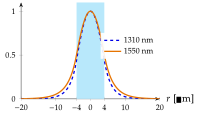
At of the power runs in the cladding. That is why bends cost more at than at , and why the cladding must be many decay lengths thick.