Section 7.6 · Problems · 2 of 4
Problem 7.6.2: Surface waves on a coated conductor
Surface waves on a coated conductor
#A perfectly conducting plane is coated with a lossless dielectric layer, , , of thickness . Above it is air. Surface waves of travel along .
- Which surface-wave modes propagate, and what are their cutoff frequencies?
- For the TM mode find , and , and the height above the coating at which the field has dropped by .
- Find the surface impedance seen from the air. Is it inductive or capacitive?
- Up to which thickness does the coating guide TM alone at ?
Adapted from: D. K. Cheng, Field and Wave Electromagnetics, 2nd ed., Problem P.10-36.
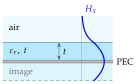
Image theory (Section 7.6.9): the metal plane can replace the midplane of a slab of thickness for every slab mode whose tangential electric field already vanishes there. These are the odd TE () and the even TM (). The slab is that of Problem 7.6.1, so its roots can be reused.
, , , and .
, as in Problem 7.6.1. The cutoffs of the slab modes are , and the coated plane keeps only
At TM, TE and TM propagate. TE, TM and TE of the full slab are absent: they would need on the metal.
TM: with gives , . With in place of ,
Above the coating , the height above the surface. means : .
In the air , so
A positive reactance: the surface is inductive.
TE must be below cutoff: , so
Only the odd TE and even TM branches survive the metal below. Read of TM.
. is the TM value of the slab in the remark of Problem 7.6.1, as image theory says it must be.
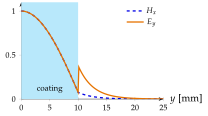
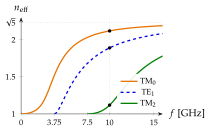
A TE surface wave would see a capacitive , Eq. (7.6.33). A metal surface made inductive by a coating (or by corrugations) is the classic way to bind a TM surface wave, for surface-wave antennas and launchers. Exercise 7.6.3 runs this problem backwards: it prescribes the reactance and asks for the coating.