Section 7.6 · Worked examples · 2 of 2
Worked example 7.6.2: A 10.6 GHz dielectric resonator
About the worked examples of Section 7.6
Two short calculations tied to the applications, with the fibre results of this section and the resonance formula of the dielectric resonator. They use no new physics. A good way to use them: read the given quantities, produce the formula from the corresponding application yourself, and only then put the numbers in. Constants: , .
A 10.6 GHz dielectric resonator
#Given. The local oscillator of a satellite-TV receiver is stabilised by a TE puck: , , temperature coefficient , aspect ratio . Empirical resonance formula (radius and height in mm): .
Find. (a) The radius and height of the puck. (b) Its wavelength scale and its unloaded . (c) The drift from to . (d) The side of an air-filled cubic metal cavity (TE, ) at the same frequency, and the volume ratio.
With the aspect ratio fixed, the empirical formula Eq. (7.6.44) is linear in . All dimensions of a dielectric resonator scale with the wavelength in the ceramic, .
a diameter of and a height . Back in the formula: .
, and in the ceramic : the puck is about one wavelength across. The dielectric alone allows . Coupling and the metal box lower the loaded .
over the range, within a typical specification for this oscillator.
against for the puck: times smaller, close to .
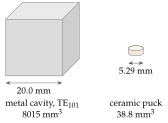
The volume falls as because all three dimensions scale with . The field is held by reflection at the ceramic surface, not by walls, so a puck a few millimetres across sits on the oscillator board next to its microstrip line and couples to it through its evanescent magnetic field.
cf. Application 7.6.2