Section 7.6 · Worked examples · 1 of 2
Worked example 7.6.1: A 1550 nm fibre span
Two short calculations tied to the applications, with the fibre results of this section and the resonance formula of the dielectric resonator. They use no new physics. A good way to use them: read the given quantities, produce the formula from the corresponding application yourself, and only then put the numbers in. Constants: , .
A 1550 nm fibre span
#Given. An span of the fibre of Problem 7.6.3 ( at , at , at ). Transmitter , receiver needs at . Two connectors ( each), splices ( each).
Find. (a) The power budget and margin at . (b) The same at . (c) The chromatic spread for a source width of and of , against the bit slot. (d) What would modal dispersion do in the multimode fibre of Problem 7.6.4?
In decibels the losses add: , Eq. (7.6.43). Chromatic dispersion spreads a pulse by , Eq. (7.6.42), and a stream has a bit slot of .
Fibre , connectors , splices : in total. , a margin of above .
At the fibre alone costs , the total is and : short. The loss window decides for .
A directly modulated laser () smears the bits into each other. A narrow-line laser with an external modulator () is fine. At , but (b) fails.
Step-index multimode: , which is bit slots. Only a single-mode fibre ( here) can carry over .
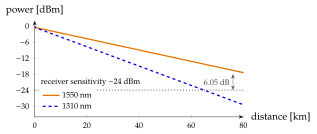
Loss favours , dispersion favours . Long-haul systems take and handle the dispersion with narrow sources, dispersion-compensating fibre or digital processing, and put an erbium-doped fibre amplifier at the end of each span.
cf. Application 7.6.1