Section 7.7 · Topic 3 of 10
7.7.3 Effective permittivity: Hammerstad's formula
Accurate numerical solutions of the static problem have been condensed into closed-form curve fits. For a thin strip, Hammerstad's fit is
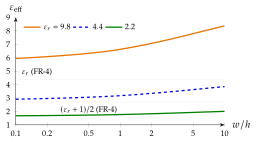
Effective permittivity of a microstrip line
In plain words
starts from the plain average of substrate and air, , and moves towards as the strip gets wider, because more of the field is then trapped under the strip.
- Narrow strip, : (plus a small correction): half of the field is in the air, as for a thin wire lying on the surface.
- Wide strip, : , the parallel-plate limit.
- depends on the ratio only: scale the cross-section up or down and nothing changes. A design for one substrate thickness is a design for all.
The fit is accurate to about (Hammerstad, 1975). The same leading terms are Sadiku's Eq. (11.70), and Orfanidis (Section 11.3) gives the refined Hammerstad–Jensen fits, which yield and for the FR-4 line with (with ), against and from Eq. (7.7.4) and the formulas of the next subsection. Figure 7.7.3 shows for three common substrates.