Section 7.7 · Further exercises · 1 of 5
Exercise 7.7.1: Reading a TDR record
Five further exercises on microstrip lines, in the spirit of Problem 7.7.1 and the home exercises, graded from easy to harder: reading a time-domain reflectometer record, the manufacturing tolerance of a controlled-impedance line, the quality factor of a microstrip resonator, the choice of substrate for a radar, and a measurement of the substrate permittivity. They use only the relations listed at the head of this subsection.
Reading a TDR record
#A time-domain reflectometer (TDR) sends a fast voltage step into a long microstrip trace on a test coupon. The record shows a flat level corresponding to , and the reflection from the open far end arrives after the step entered the trace.
- Find , and the delay per cm.
- Find and .
- Find and of the same strip with the substrate removed.
- A cross-section shows . Find of the laminate and check .
- What would the delay per cm be for a stripline buried in the same laminate?
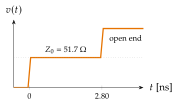
The round trip takes . With and the quasi-TEM relations give , and the air line (, unchanged). Hammerstad's is linear in for a given , so it can be inverted in one line.
, and the delay is .
does not see the substrate: and .
With , gives
Check: and .
A stripline has all its field in the laminate: the delay is .
.
TDR coupons are etched on the panel edge of production boards: the measured proves the impedance control and the delay reveals . Outer-layer (microstrip) and inner-layer (stripline) traces of equal length differ by in delay, which matters for the timing of parallel buses.
cf. Problem 7.7.1