Section 7.7 · Further exercises · 3 of 5
Exercise 7.7.3: The Q of a half-wave microstrip resonator
About the further exercises of Section 7.7
Five further exercises on microstrip lines, in the spirit of Problem 7.7.1 and the home exercises, graded from easy to harder: reading a time-domain reflectometer record, the manufacturing tolerance of a controlled-impedance line, the quality factor of a microstrip resonator, the choice of substrate for a radar, and a measurement of the substrate permittivity. They use only the relations listed at the head of this subsection.
The of a half-wave microstrip resonator
#An open-ended half-wave resonator for is cut from the line on RO4003C of Table 7.7.1 (, , , , copper). Neglect end effects and radiation, and use for a resonant line section.
- Find , and the length.
- Find and .
- Find , , the unloaded and the bandwidth. Show that .
- Repeat for the line on FR-4 (). Which loss dominates in each case?
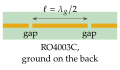
A resonator stores energy and loses a fraction of it per cycle. For a line section the losses per unit length and the phase per unit length combine into , and separate losses add as .
, , .
RO4003C: , , , , and .
and .
a bandwidth of . Since , : it depends neither on nor on the length.
FR-4 (, ): , , (), , (), so
On RO4003C the copper loss dominates (thin substrate, narrow strip), on FR-4 the dielectric loss dominates by far.
for FR-4: . The thicker FR-4 board has the wider strip ( against ), hence the smaller current density and the higher .
Filters built of such resonators lose more in the passband the lower is compared with divided by the filter bandwidth. A filter wide is feasible on RO4003C but hopeless on FR-4, whose is below . Where a higher is needed, the dielectric resonators of Application 7.6.2 in Section 7.6 () take over.
cf. Problem 7.7.1