Section 7.7 · Further exercises · 5 of 5
Exercise 7.7.5: Which permittivity does the laminate really have?
About the further exercises of Section 7.7
Five further exercises on microstrip lines, in the spirit of Problem 7.7.1 and the home exercises, graded from easy to harder: reading a time-domain reflectometer record, the manufacturing tolerance of a controlled-impedance line, the quality factor of a microstrip resonator, the choice of substrate for a radar, and a measurement of the substrate permittivity. They use only the relations listed at the head of this subsection.
Which permittivity does the laminate really have?
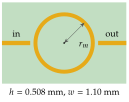
#A laminate datasheet quotes (process value) and (design value). To decide, a ring resonator is etched on it: , , mean radius , loosely coupled to two feed lines. It resonates when its circumference is . Measured: , , , .
- Find at each resonance.
- Find from with Hammerstad's static formula.
- Why does rise with ? Predict the four values with Getsinger's model and the of (b).
- Correct (b) for dispersion. Which datasheet value applies, and where would be with the other?
gives at each resonance. Hammerstad's is linear in and inverts in one line (Exercise 7.7.1). The lowest resonance is closest to the static case. Dispersion makes the higher ones read high.
.
| [GHz] | measured | |
|---|---|---|
| Getsinger, | Getsinger, | |
|---|---|---|
, :
As rises the field moves from the air into the substrate (Section 7.7.8), so rises towards . With : , , . Getsinger's model gives the first column of the second table: the same rise as measured, but too high everywhere, because the static value used in (b) already contained the small dispersion at .
Requiring Getsinger's to equal gives (static ), and then all four resonances agree to (last column). The process value applies. With the static would be and , lower than measured.
: , squared . The rise from to () is the size Getsinger's model predicts for up to .
The "design" value of a laminate datasheet is the one that reproduces circuit behaviour in simulations, often extracted with a different method (here it is higher). The ring has no open ends, so it needs no end-effect correction, which is why it is the standard way to measure . Its curvature and the coupling gaps shift the resonances slightly, and loose coupling keeps that shift small.
cf. Home exercise 7.7.2