Section 7.2 · Further exercises · 5 of 5
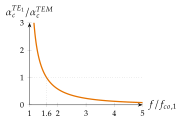
Exercise 7.2.5: Why the TE_1 loss falls with frequency
About the further exercises of Section 7.2
Five further exercises on the parallel-plate guide, in the spirit of Problems 7.2.1–7.2.5 and the home exercises, graded from easy to harder. Exercise 7.2.1 is about the TEM line, Exercise 7.2.2 about exciting the modes, Exercises 7.2.3 and 7.2.4 about the TE and TM modes at work, and Exercise 7.2.5 about the conductor losses.
Why the TE loss falls with frequency
#- Derive the conductor attenuation of the TE mode of a parallel-plate guide, quoted in Eq. (7.2.37), from .
- Above which frequency does TE lose less in the plates than TEM? Give the exact ratio .
- Copper plates, air, : find the crossover frequency and of TEM, TE and TM at and .
- Explain the trend with the zig-zag picture.
Write the TE fields with one constant . The power carried is the integral of across the gap, the power lost is on both plates, and on a plate the only tangential magnetic field of TE is .
With , Eq. (7.2.12) gives , so and
On each plate (normal) and , hence and . Then
and with , , :
with . Equal losses: , , so
Above this frequency TE has the lower conductor loss.
, crossover at . With at and at ():
The two plane waves of TE meet the plates at the angle with , and their magnetic field has the component along at the plates. As grows, : the waves graze the plates, the wall current shrinks and so do the bounces per metre. TEM and TM modes always have their full tangential to the plates.
Far above cutoff : from to this predicts a factor , and with the change of () the factor is , exactly . At , so TE, TM, TE and TM propagate too: low loss in TE is bought with a strongly overmoded guide.
The same mechanism makes the TE mode of a circular guide (Section 7.4) famous: its loss falls without limit as the frequency rises, and it was once the candidate for long-distance millimetre-wave trunk lines, until optical fibres took over.
cf. Problem 7.2.4