Section 7.2 · Further exercises · 4 of 5
Exercise 7.2.4: Two modes beating along the guide
About the further exercises of Section 7.2
Five further exercises on the parallel-plate guide, in the spirit of Problems 7.2.1–7.2.5 and the home exercises, graded from easy to harder. Exercise 7.2.1 is about the TEM line, Exercise 7.2.2 about exciting the modes, Exercises 7.2.3 and 7.2.4 about the TE and TM modes at work, and Exercise 7.2.5 about the conductor losses.
Two modes beating along the guide
#An air-filled parallel-plate guide with is driven at by a short -directed probe on the bottom plate, which launches the TEM and the TM mode with equal amplitudes on the bottom plate and in phase at .
- Which modes propagate? Find of TEM and TM.
- Find on the bottom and on the top plate as functions of , and the beat length.
- Find the ratio of the powers carried by the two modes.
- How does the beat length change at ?
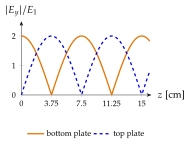
The two modes travel with different phase constants, so their relative phase changes along by . TEM has the same on both plates, while TM has , which changes sign from bottom to top: where the two add on one plate they cancel on the other.
and : TEM, TM and TE propagate (the probe does not excite TE, which has no ). , and .
On the plates and , so
The field sits on the bottom plate at , and and on the top plate at and .
TEM: . TM with peak transverse field : with . The ratio is .
At : , , .
for every : the field moves from plate to plate, but the two modes are orthogonal and carry their powers independently, so the total power does not change along the guide.
The beat pattern is how an unwanted second mode shows itself in measurements: a probe moved along the guide sees a slow ripple of period on top of the guide-wavelength pattern. The same beating between two modes is the working principle of directional couplers and of mode converters, which are cut to a length so that the power ends up where it is wanted.
cf. Problem 7.2.2