Section 7.2 · Further exercises · 3 of 5
Exercise 7.2.3: A metal-plate lens
About the further exercises of Section 7.2
Five further exercises on the parallel-plate guide, in the spirit of Problems 7.2.1–7.2.5 and the home exercises, graded from easy to harder. Exercise 7.2.1 is about the TEM line, Exercise 7.2.2 about exciting the modes, Exercises 7.2.3 and 7.2.4 about the TE and TM modes at work, and Exercise 7.2.5 about the conductor losses.
A metal-plate lens
#A microwave lens is made of a stack of thin parallel metal plates, spacing , with the electric field of the incoming wave parallel to the plates. Each channel between two plates is a parallel-plate guide carrying the TE mode, so the stack behaves like a medium of index .
- Find for at , and check that only TE is excited.
- Estimate the reflection at the face of the lens from the wave impedance.
- The lens is zoned: its thickness jumps wherever the phase advance reaches . Find the zone step.
- Find the phase error of one zone step at and .
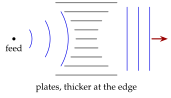
In each channel with , so : a phase velocity above . A lens with must be thicker at the edge than at the centre. The face of the stack sees the wave impedance .
. requires :
With parallel to the plates only TE modes, which have , are excited, and of these only TE propagates (and the field of a broad incoming wave, even across the channel, couples only to odd anyway).
, so and of the power is reflected at the face (the estimate ignores the mismatch between the uniform incoming field and the mode).
A length of the stack advances the phase by relative to air. A full cycle needs .
At another frequency the same step gives :
at : , and .
The metal-plate lens is dispersive because the guide is: changes from to over a band, so the lens focuses well only near its design frequency. A smaller index gives a thinner lens but lies closer to cutoff, with more dispersion and more reflection. Practical designs use to and a matching layer on the faces.
cf. Problem 7.2.3