Section 7.2 · Further exercises · 2 of 5
Exercise 7.2.2: Which modes does a source excite?
About the further exercises of Section 7.2
Five further exercises on the parallel-plate guide, in the spirit of Problems 7.2.1–7.2.5 and the home exercises, graded from easy to harder. Exercise 7.2.1 is about the TEM line, Exercise 7.2.2 about exciting the modes, Exercises 7.2.3 and 7.2.4 about the TE and TM modes at work, and Exercise 7.2.5 about the conductor losses.
Which modes does a source excite?
#An air-filled parallel-plate guide with is driven at by a source in the plane that is uniform along . A source excites a mode only if the overlap integral of its current with the field of the mode is nonzero. Which propagating modes are excited by
- a thin current along at ,
- the same current at ,
- a sheet of -directed current filling the whole gap uniformly,
- the same sheet filling only ?
Give of every excited mode.
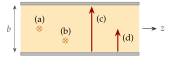
List the propagating modes, then test each source against each mode: an -directed current meets only of the TE modes, a -directed current only , which is uniform for TEM and for TM.
, , . At : TEM, TE, TM, TE, TM. With , , :
Overlap : for , for . Only TE (the source sits on the node of TE).
, : TE and TE.
TEM: . TM: for every . Only the TEM wave.
TEM: . TM: : nonzero for , zero for . TEM and TM.
Every source also drives evanescent modes () that it does not cancel by symmetry, for instance TE in (a) () and TM in (d). They decay with , , and are gone within a few millimetres.
Symmetry is the designer's tool for clean excitation. A source in the middle of the gap cannot excite modes whose field vanishes there, and a uniform source across the gap couples only to the uniform TEM wave: this is how the tapered feed of a TEM cell (Worked example 7.2.1) keeps the higher modes out.
cf. Home exercise 7.2.3