Section 7.3 · Topic 2 of 11
7.3.2 TM modes
The equation and the boundary conditions
For the TM case but , and satisfies the Helmholtz equation
Putting in Eq. (7.3.3), the transverse fields follow from alone:
On a perfect conductor the tangential electric field vanishes. is tangential to all four walls, so
These four conditions are enough. On the walls and the other tangential component is , which by Eq. (7.3.8) is proportional to . If vanishes all along the wall, so does its derivative along the wall, and there automatically. In the same way vanishes on and .
Separation of variables
With and , equation (7.3.7) becomes a two-dimensional equation in the cross-section,
The cross-section is a rectangle and the boundary conditions are stated on lines const and const, so we try a product of a function of alone and a function of alone:
Substituting and dividing by ,
The first term depends on only, the second on only, and their sum is the constant for every and every . Keep fixed and vary : the first term cannot change. Each term must therefore be a constant by itself. Calling the constants and ,
two ordinary equations of the harmonic oscillator, with the general solutions
Applying the walls
The conditions (7.3.9) become conditions on and :
with The constants and cannot vanish, otherwise there is no field at all, so and , and only a discrete set of and is allowed. Then
is a standing wave across the guide (Figure 7.3.2a): half-periods of a sine fit across the width and across the height , with nodes on the walls. Along it is a travelling wave. Writing for the product of the two constants, the TM mode is
Neither nor can be zero: or makes , so , and with it every transverse component, since they are all derivatives of . The lowest TM mode is TM.
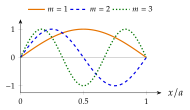
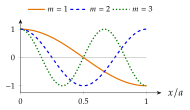
The complete TM field
The general TM solution is the sum of all the modes, , and the transverse components follow from Eq. (7.3.8) by differentiating each term:
Each term is one TM mode, which travels with its own . Two checks are worth making. First, the ratios of the transverse components of one mode are
the TM wave impedance of Eq. (7.3.4). Second, vanishes on and , and vanishes on and : the tangential electric field is zero on all four walls, as it must be.
Cutoff frequencies of the TM modes
in Eq. (7.3.15) is real, and the mode propagates, only if . Setting gives the cutoff frequency of the TM mode,
and the lowest TM mode is TM, with .
The transverse fields follow from Eq. (7.3.8), , the cutoff is Eq. (7.3.18) and the wave impedance is . The lowest TM mode is TM.
The walls force to be zero all round the edge of the cross-section, so it can only be a pattern of half sine waves, across and up. Each pattern is one mode, and the finer the pattern, the higher the frequency at which it starts to travel.
TM is the lowest TM mode, not the lowest mode of the guide. The TE mode of the next subsection has the cutoff , which is lower than for any . The dominant mode of the rectangular guide is TE.