Section 7.3 · Topic 4 of 11
7.3.4 Cutoff frequencies and the mode chart
One formula covers both families. With ,
TE with not both zero, TM with A mode propagates when , with , , , and the wave impedance of Eqs. (7.3.4) and (7.3.5), and is evanescent below.
A mode can travel only if the half-wavelengths of the filling fit its pattern into the cross-section: for TE the width must exceed half a wavelength. Every finer pattern needs a shorter wavelength, that is a higher frequency.
For the common proportion the cutoffs in units of are :
| mode | |
|---|---|
| TE | |
| TE, TE | |
| TE, TM | |
| TE, TM | |
| TE |
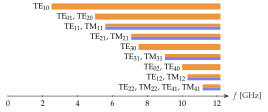
A mode chart shows the same information graphically (Figure 7.3.3). Each bar starts at the cutoff of its mode and extends to the right, over all the frequencies at which the mode propagates. A vertical line at the operating frequency crosses the bars of all the propagating modes. Below only TE propagates: when the guide has a full octave of single-mode band, from to .
Which modes propagate at in an air-filled guide with and ?
, , , . Five modes propagate: TE, TE, TE, TE and TM.