Section 7.3 · Further exercises · 9 of 10
Exercise 7.3.9: Counting the modes of an oversized guide
About the further exercises of Section 7.3
Ten further exercises in the spirit of Problems 7.3.1–7.3.5, the home exercises and the worked examples, graded from easy to harder. Exercises 7.3.1–7.3.2 are about cutoffs and dimensions, Exercises 7.3.3–7.3.5 about power, wall currents and loss, Exercises 7.3.6–7.3.8 about dispersion and pairs of modes, and Exercises 7.3.9–7.3.10 about many modes and degenerate modes. They use only the results listed at the head of this subsection, together with the dielectric attenuation .
Counting the modes of an oversized guide
#A WR-90 guide (, , air) is used far above its band.
- List all modes that propagate at .
- Show that the mode propagates when the point lies inside the quarter ellipse with , , and deduce the estimate for the total number of modes. Evaluate it at .
- Improve the estimate for TE and TM separately with the lattice points on the axes.
- Estimate the number of modes at . The exact count is TE and TM.
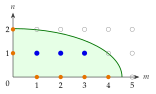
The cutoff condition is the inside of an ellipse in the plane. Each lattice point occupies unit area, so the number of points is about the area of the quarter ellipse, and each interior point counts twice (TE and TM).
and . Below : TE (), TE (), TE (), TE and TM (), TE (), TE and TM (), TE and TM (), TE (), TE (): TE and TM, twelve modes.
is equivalent to . The quarter ellipse has the area , roughly the number of lattice points in it, and counting TE and TM gives
At , , and .
The points on the axes ( or ) are TE modes only, there are about of them, and the area estimate counts half of each. Hence
At : , that is TE and TM, against and . At these small numbers the count is still lumpy.
At : , , and : , and , against the exact .
Just below the TE cutoff () the formulas give and , against the true and : the estimate is meant for many modes.
The result, one mode for every of cross-section, does not depend on the shape of the guide: it is the two-dimensional form of the rule that counts the modes of a cavity (Section 7.8) and of black-body radiation. An oversized guide has low loss, but every bend and flange spreads its power over a hundred modes with different velocities, so such guides are used only for short, straight runs or with special low-conversion designs.
cf. Problem 7.3.5