Section 7.3 · Further exercises · 8 of 10
Exercise 7.3.8: A square-guide polariser
About the further exercises of Section 7.3
Ten further exercises in the spirit of Problems 7.3.1–7.3.5, the home exercises and the worked examples, graded from easy to harder. Exercises 7.3.1–7.3.2 are about cutoffs and dimensions, Exercises 7.3.3–7.3.5 about power, wall currents and loss, Exercises 7.3.6–7.3.8 about dispersion and pairs of modes, and Exercises 7.3.9–7.3.10 about many modes and degenerate modes. They use only the results listed at the head of this subsection, together with the dielectric attenuation .
A square-guide polariser
#A square air-filled guide, , carries . A wave linearly polarised at (equal, in-phase TE and TE amplitudes) enters a section in which the height is reduced to , the width staying (reflections at the steps are ignored).
- In which band does the square guide carry only TE and TE?
- Find of both modes in the reduced section and the length that turns the wave into a circularly polarised one.
- Which component leads at the output, and what is the sense of rotation (IEEE convention of Section 6.1)?
- Find the phase difference produced by the same at and .
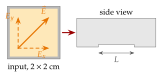
TE () depends only on , TE () only on . Reducing raises the cutoff of TE and lowers its , so accumulates less phase lag than and comes out ahead. Circular polarisation needs a difference.
and the next modes, TE and TM, start at : the band is –.
, , :
and . In the section and TE starts at , so it still carries the two modes only.
Each component lags by , and (TE, smaller ) lags less: leads by . At a fixed point and , so turns from to . With the thumb along this is right-handed circular polarisation (RHCP).
With the same : at , at , errors of and .
At : . The error grows towards the TE cutoff (), where changes fastest.
A phase error from leaves an elliptical wave with the axial ratio , that is () at : a simple squeezed section is narrow-band. Satellite feeds use longer sections with dielectric vanes, corrugations or a stepped septum to flatten , and two such polarisers in one feed carry a left-hand and a right-hand channel at the same frequency.
cf. Home exercise 7.3.4