Section 7.3 · Further exercises · 7 of 10
Exercise 7.3.7: TE_{01} or TE_{10}?
About the further exercises of Section 7.3
Ten further exercises in the spirit of Problems 7.3.1–7.3.5, the home exercises and the worked examples, graded from easy to harder. Exercises 7.3.1–7.3.2 are about cutoffs and dimensions, Exercises 7.3.3–7.3.5 about power, wall currents and loss, Exercises 7.3.6–7.3.8 about dispersion and pairs of modes, and Exercises 7.3.9–7.3.10 about many modes and degenerate modes. They use only the results listed at the head of this subsection, together with the dielectric attenuation .
TE or TE?
#A copper guide with and , air-filled, is operated at .
- Which modes propagate?
- Write of TE without a new derivation, and evaluate of TE and TE.
- Find of both modes and the power each carries at a peak field of .
- Why is the guide always used in TE, with across the narrow dimension?
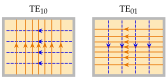
TE is TE of the same guide turned through : its runs along and its field varies across . Every TE result therefore holds for TE with and exchanged.
, , , : TE and TE propagate.
Exchanging and in Eq. (7.3.42),
, , :
: and . With and ,
TE has the lowest cutoff, so it is the only mode in the band , and at any frequency it has the lower loss and the higher power. TE exists only above , where TE is always present too, and whatever excites one also tends to excite the other at bends and steps.
.
This guide, with , has a single-mode band of only to , and at it is a two-mode guide. The two modes have orthogonal fields, so in a perfectly straight guide they travel independently: square and nearly square guides exploit exactly this to carry two polarisations at once (Exercise 7.3.8).
cf. Problem 7.3.4