Section 7.3 · Further exercises · 6 of 10
Exercise 7.3.6: Locating a fault with a frequency sweep
About the further exercises of Section 7.3
Ten further exercises in the spirit of Problems 7.3.1–7.3.5, the home exercises and the worked examples, graded from easy to harder. Exercises 7.3.1–7.3.2 are about cutoffs and dimensions, Exercises 7.3.3–7.3.5 about power, wall currents and loss, Exercises 7.3.6–7.3.8 about dispersion and pairs of modes, and Exercises 7.3.9–7.3.10 about many modes and degenerate modes. They use only the results listed at the head of this subsection, together with the dielectric attenuation .
Locating a fault with a frequency sweep
#A long air-filled WR-137 run () feeds an antenna. A swept reflectometer at the input sees a ripple in the reflection coefficient, caused by a small reflection at the input flange interfering with the echo from a dent in the guide. Near the ripple repeats every .
- Show that the ripple period is and find the distance to the dent.
- What distance would one find with instead of ?
- Find the ripple period at and at .
- Show that the number of ripples between and is exactly and count them between and .
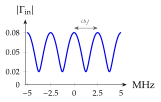
The echo from the dent travels and returns with the phase relative to the flange reflection. The two add or cancel each time changes by , and changes with frequency at the rate .
One ripple: with , hence . At , , and :
: ignoring the dispersion of the guide puts the fault too far.
At , and . At , and .
In an air guide exactly, so the number of ripples is
A free-space estimate with would give , far from . The mean period over the band, , lies between the end values.
This is frequency-domain reflectometry. A Fourier transform of the swept turns the ripples into a peak at the round-trip delay, but in a waveguide the frequency axis must first be converted to , as in (d). Otherwise the peak is smeared and misplaced by the dispersion. Network analysers have a “waveguide” option in their time-domain mode for exactly this reason.
cf. Home exercise 7.3.2