Section 7.3 · Further exercises · 5 of 10
Exercise 7.3.5: Smaller with a dielectric, but lossier
About the further exercises of Section 7.3
Ten further exercises in the spirit of Problems 7.3.1–7.3.5, the home exercises and the worked examples, graded from easy to harder. Exercises 7.3.1–7.3.2 are about cutoffs and dimensions, Exercises 7.3.3–7.3.5 about power, wall currents and loss, Exercises 7.3.6–7.3.8 about dispersion and pairs of modes, and Exercises 7.3.9–7.3.10 about many modes and degenerate modes. They use only the results listed at the head of this subsection, together with the dielectric attenuation .
Smaller with a dielectric, but lossier
#An air-filled copper guide, , , is used at . A designer wants a smaller guide for the same frequency and fills it with polyethylene (, ), scaling the cross-section so that stays the same.
- Find the new dimensions.
- Show that at the same the copper loss grows by the factor , and evaluate both.
- Find the dielectric loss and the total, and compare with the air guide.
- Compare the powers carried at the same peak field of .
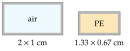
All cutoffs scale with , so the same needs every dimension divided by . In the bracket and are unchanged, depends on only, and is divided by .
: , . In both guides , and .
. With at and the bracket :
:
The total is , times the of the air guide.
: is divided by and by , so :
The scaled guide has times less area: against . At the same field the power per unit area grows by (the filled guide has the lower impedance) and the area falls by , net .
The dielectric costs twice: its own loss, which here exceeds the wall loss, and a larger wall loss because the smaller guide crowds the same current into narrower walls. Filled guides are therefore used in short components (filters, phase shifters, transitions), not in long runs. The breakdown strength of the solid is far higher than that of air, so the power limit is usually set by heating, not by the field.
cf. Problem 7.3.3