Section 7.3 · Further exercises · 4 of 10
Exercise 7.3.4: Wall currents, charges and slots
About the further exercises of Section 7.3
Ten further exercises in the spirit of Problems 7.3.1–7.3.5, the home exercises and the worked examples, graded from easy to harder. Exercises 7.3.1–7.3.2 are about cutoffs and dimensions, Exercises 7.3.3–7.3.5 about power, wall currents and loss, Exercises 7.3.6–7.3.8 about dispersion and pairs of modes, and Exercises 7.3.9–7.3.10 about many modes and degenerate modes. They use only the results listed at the head of this subsection, together with the dielectric attenuation .
Wall currents, charges and slots
#An air-filled WR-90 guide (, ) carries in the TE mode at .
- Find , , and the largest surface charge density.
- Write and on the top wall and verify .
- Five narrow slots are cut: (1) along on the centre line of the broad wall, (2) along at , (3) across the broad wall, centred on , (4) vertical in a narrow wall, (5) in a narrow wall, tilted from the vertical. Which radiate? Give the peak current density each one interrupts.
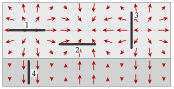
On a perfect conductor and . A narrow slot is harmless when it runs along the current lines and radiates when it cuts them: the interrupted current must jump the gap as displacement current, and the slot becomes a source.
, , , :
On the top wall :
Then, using ,
Since , this is . Numerically .
On the broad wall the current crossing a longitudinal slot is , the current crossing a transverse slot . On the narrow walls the current is vertical, .
.
Slot 1 is the slotted measuring line. Slot 2 is the element of the broad-wall array of Application 7.3.2: the offset sets how much power each slot takes. Slot 3 is a series slot, slot 5 the element of narrow-wall arrays, whose tilt sets the coupling and whose alternating sign gives the extra . The continuity check of (b) shows why the broad-wall current must turn sideways near the edges: it closes through the charge on which the field ends.
cf. Home exercise 7.3.3