Section 7.3 · Further exercises · 3 of 10
Exercise 7.3.3: Power rating with a mismatched load
About the further exercises of Section 7.3
Ten further exercises in the spirit of Problems 7.3.1–7.3.5, the home exercises and the worked examples, graded from easy to harder. Exercises 7.3.1–7.3.2 are about cutoffs and dimensions, Exercises 7.3.3–7.3.5 about power, wall currents and loss, Exercises 7.3.6–7.3.8 about dispersion and pairs of modes, and Exercises 7.3.9–7.3.10 about many modes and degenerate modes. They use only the results listed at the head of this subsection, together with the dielectric attenuation .
Power rating with a mismatched load
#An air-filled WR-187 guide (, ) carries in the TE mode. For safety the peak field anywhere in the guide must stay below .
- Find the largest power into a matched load.
- The antenna has a VSWR of . Show that the largest power that can be delivered is the matched value divided by the VSWR, and evaluate it. How far apart are the field maxima?
- The guide is pressurised to (absolute) with dry air, which roughly doubles the breakdown field. What power can be delivered now?
- An arc at the antenna acts as a short circuit. Up to which incident power does the feed itself stay safe?
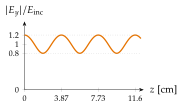
With a reflection, the incident and reflected waves add to at the maxima of the standing wave, while the delivered power is (Section 6.3). The field limit therefore caps , and the delivered power follows.
, , :
. The field limit requires , so and
With : and . The maxima repeat every : , , so they are apart.
doubled means multiplied by : .
A short gives and a peak field : the incident power must stay below at , a quarter of the matched rating, although nothing is delivered.
The reflected power at is of , that is , and .
Every mismatch is a hidden derating, and the worst case is a fault at the far end. High-power radars therefore watch the reflected power and switch off within microseconds when it rises, and their feeds are dried and pressurised. Pressure helps up to a few bar. Beyond that the guide is filled with sulphur hexafluoride, whose breakdown field is about three times that of air.
cf. Worked example 7.3.1