Section 7.3 · Further exercises · 2 of 10
Exercise 7.3.2: How high should the guide be?
About the further exercises of Section 7.3
Ten further exercises in the spirit of Problems 7.3.1–7.3.5, the home exercises and the worked examples, graded from easy to harder. Exercises 7.3.1–7.3.2 are about cutoffs and dimensions, Exercises 7.3.3–7.3.5 about power, wall currents and loss, Exercises 7.3.6–7.3.8 about dispersion and pairs of modes, and Exercises 7.3.9–7.3.10 about many modes and degenerate modes. They use only the results listed at the head of this subsection, together with the dielectric attenuation .
How high should the guide be?
#A copper guide of fixed width (the width of WR-90) is to carry in the TE mode. Four heights are considered: , , and .
- Find the single-mode band of each guide. Which one fails at ?
- Find the power each can carry at before the peak field reaches .
- Find of each at .
- Which height would you choose for a single-frequency link, and which for a wideband system?
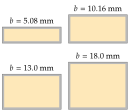
The TE field does not depend on , and neither does . The height enters in three places: the cutoff of TE, the power at a given field, and the loss, which is dominated by the factor .
for all four, , and :
The guide carries TE as well at : it fails.
, and :
and :
For a single frequency the guide is better than the standard one: less loss and more power, while still lies below its TE cutoff. For a wideband system the standard is the right choice: it is the tallest guide that keeps the full octave – single-mode.
The standard WR-90 values, and at , are those of Section 7.3.6. Halving halves the power and almost doubles the loss: , slightly less than because the narrow-wall term shrinks too.
Reduced-height guides () are used where space is short or where a low impedance is wanted, for example to match a diode mount. Tall guides with appear in high-power systems working at one frequency. The standard WR series keeps because a component catalogue must cover the whole band.
cf. Problem 7.3.4