Section 7.3 · Further exercises · 1 of 10
Exercise 7.3.1: Sizing a guide from a frequency sweep
Ten further exercises in the spirit of Problems 7.3.1–7.3.5, the home exercises and the worked examples, graded from easy to harder. Exercises 7.3.1–7.3.2 are about cutoffs and dimensions, Exercises 7.3.3–7.3.5 about power, wall currents and loss, Exercises 7.3.6–7.3.8 about dispersion and pairs of modes, and Exercises 7.3.9–7.3.10 about many modes and degenerate modes. They use only the results listed at the head of this subsection, together with the dielectric attenuation .
Sizing a guide from a frequency sweep
#An air-filled rectangular guide of unknown size is swept in frequency, and a mode analyser counts the propagating modes. The count jumps from to at , from to at and from to at .
- Explain why the second mode must be TE, not TE, and find and .
- Which modes start at , and why two at once? Where are the next two jumps?
- Find and of the dominant mode at .
- A second guide of the same width has its count jump from straight to at . What is its height? What if the count had gone from to at ?
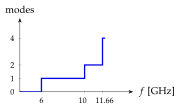
The first cutoff of an guide is always TE, at . The second is TE at or TE at , whichever is lower. A jump by two signals a degenerate pair TE, TM with .
. TE would start at . A mode at , below , can only be TE, so
: TE and TM, which have the same and hence the same cutoff. The next jumps are TE at (count ) and TE, TM at (count ).
At and :
Two modes at once at exactly : TE and TE coincide, so and . A single new mode at would be TE alone, with TE somewhere above: then , and its value would follow from the next jump only.
With and the full list is , , (two), , (two), , consistent with the measured jumps.
The first guide has , so its single-mode band is only –, a ratio of instead of the octave of a guide with . A sweep alone tells the size only if one knows which mode each jump belongs to: an probe on the axis, which sees TM but no TE mode, settles such questions in practice.
cf. Problem 7.3.1