Section 5.5 · Further exercises · 10 of 10
Exercise 5.5.10: Scalar potential of a short element, Lorenz gauge
About the further exercises of Section 5.5
Ten further exercises in the spirit of Problems 5.5.1–5.5.6, the home exercises and the worked examples, graded from easy to harder. Exercises 5.5.1–5.5.2 are about travelling pulses, Exercises 5.5.3–5.5.5 about the wave equation itself, Exercises 5.5.6–5.5.8 about potentials and gauges, and Exercises 5.5.9–5.5.10 about retarded potentials. They use only the equations listed at the head of this subsection. All media are nonmagnetic.
Scalar potential of a short element, Lorenz gauge
#A short element of length on the -axis carries an arbitrary current . Charge conservation piles up at its upper end and at its lower end, . (a) Show that at a distance , in the direction from the -axis, the retarded scalar potential is
(b) With , verify the Lorenz gauge. (c) For , , , , find the amplitude of , the ratio of the two terms of , and the amplitude of on the axis at and . Compare with .
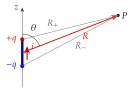
The retarded scalar potential of two point charges at distances , expanded to first order in . The derivative with respect to acts both on the and on the retarded time, and the second part is new.
The two point charges give
To first order in , , and
which gives the stated formula. The first term is the static dipole potential of the moment (Section 3.3), the second is new and comes from the retardation.
depends only on , and :
all at the retarded time . The sum is zero: the retarded potentials of a source that conserves charge satisfy the Lorenz gauge (Home exercise 5.5.3).
, of amplitude . The ratio of the amplitudes of the second to the first term is : at and at . The two terms are a quarter period apart, so on the axis ()
against at and at .
For only the second term survives, . On the axis this is , the relation of Problem 5.5.5: there the longitudinal potentials cancel in , and here, far from the element, the field along the axis likewise falls off faster than . A dipole does not radiate along its axis.
Near the element () is the quasi-static dipole potential, following the charge, and it is five times at . Far away the retardation term takes over, follows the current, and and together give the radiation field of the Hertzian dipole.
cf. Problem 5.5.6