Section 5.5 · Further exercises · 9 of 10
Exercise 5.5.9: Two synchronised transmitters on one frequency
About the further exercises of Section 5.5
Ten further exercises in the spirit of Problems 5.5.1–5.5.6, the home exercises and the worked examples, graded from easy to harder. Exercises 5.5.1–5.5.2 are about travelling pulses, Exercises 5.5.3–5.5.5 about the wave equation itself, Exercises 5.5.6–5.5.8 about potentials and gauges, and Exercises 5.5.9–5.5.10 about retarded potentials. They use only the equations listed at the head of this subsection. All media are nonmagnetic.
Two synchronised transmitters on one frequency
#Two medium-wave transmitters and , apart, are short vertical elements with the same current moment at , fed in phase. A receiver moves along the straight line between them, at the distance from the midpoint. (a) Write the retarded vector potential at the receiver and its amplitude at the midpoint. (b) Where is the first minimum nearest the midpoint, and how deep is it (ratio to the midpoint value, in dB)? (c) How far apart are successive minima? How often does a car at pass through one?
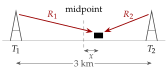
Each element gives the potential of Problem 5.5.6, both along , so they add as scalars. The two terms have the delays and : they add in phase where the path difference is a whole number of wavelengths and oppose each other half a wavelength away.
With , and :
At the midpoint both terms arrive in phase with : the amplitude is .
The phase difference of the two terms is with , . It reaches at . There the two cosines are opposite and the amplitudes almost equal, so
Minima occur wherever , that is every (Figure 5.5.21). At the car crosses one every .
At the phase difference is and the amplitude is , a maximum, slightly above the midpoint value because the nearer transmitter is now stronger. The delay difference at the first minimum is , half a period of the carrier.
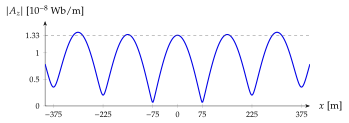
The minima are not perfect zeros only because of the of the retarded potentials. Between two analogue transmitters on one frequency the listener hears a fade every few seconds, which is why analogue broadcasting needs different frequencies for neighbouring transmitters. A digital single-frequency network (Application 5.5.3) spreads the signal over thousands of OFDM subcarriers: a delay difference puts the minima of different subcarriers at different places, and the error-correcting code restores the few that fade.
cf. Worked example 5.5.3