Section 5.5 · Further exercises · 8 of 10
Exercise 5.5.8: Potentials of a guided wave between two plates
About the further exercises of Section 5.5
Ten further exercises in the spirit of Problems 5.5.1–5.5.6, the home exercises and the worked examples, graded from easy to harder. Exercises 5.5.1–5.5.2 are about travelling pulses, Exercises 5.5.3–5.5.5 about the wave equation itself, Exercises 5.5.6–5.5.8 about potentials and gauges, and Exercises 5.5.9–5.5.10 about retarded potentials. They use only the equations listed at the head of this subsection. All media are nonmagnetic.
Potentials of a guided wave between two plates
#In free space between perfectly conducting plates at and , , a vector potential is
at . (a) Find such that satisfies the homogeneous wave equation. (b) Find from the Lorenz gauge (no static part). (c) Find and , and the amplitudes of , and in units of . (d) Show that the tangential vanishes on the plates. Why is this field not zero, unlike the longitudinal potential of Problem 5.5.5?
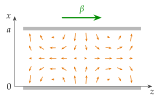
Problem 5.5.3 for the potential instead of the field, then Problem 5.5.5 with a potential that varies across the guide. The Lorenz gauge gives , and Eq. (5.5.37) gives the fields.
is a Cartesian component. Its second derivatives give , and , so the wave equation requires
The three numbers form a :: triangle: and .
, and gives
and :
In units of , with and , the amplitudes are , and :
and are both with opposite signs, so . The component of holds: and both equal .
On the plates the tangential components are and at and . In Problem 5.5.5 the two contributions to , and , cancel because . Here the variation across the guide makes , the cancellation is incomplete, and what is left is : a real field with an along the direction of travel.
This is the TM mode of the parallel-plate waveguide (Section 7.2), here obtained from a single potential component. Its cutoff is at , , and the ratio is divided by the phase velocity .
cf. Problem 5.5.5