Section 6.2 · Topic 1 of 9
6.2.1 Plane waves in a lossy medium
The complex permittivity
Consider a homogeneous, linear medium with permittivity , permeability and conductivity , free of impressed sources. In time-harmonic form (phasors with the time factor suppressed, Section 5.6) the current in the medium is the conduction current of Ohm's law, (Section 4.2.6), and the generalised Ampère law reads
The conduction current and the displacement current are both proportional to , so the two can be gathered into one term with the complex permittivity
With this substitution Eq. (6.2.1) has exactly the form of the lossless equation. Every result of the lossless plane wave of Section 6.1 therefore stays valid in the conducting medium if is replaced by . This is the whole trick of the section: we do not solve Maxwell's equations again, we only follow what the complex does to the formulas. A dielectric with polarisation losses, , is included in the same way, since its acts exactly like a conductivity.
The propagation constant
In the lossless medium the wave number is and the wave . With the wave number becomes complex,
and for a wave travelling along , . It is customary to work instead with the propagation constant , the coefficient of in the exponent:
Both notations describe the same wave. The lecture decks use where they continue the lossless notation of Section 6.1, and everywhere else. In this course we use , and write only where a problem is posed with it.
In a medium a uniform plane wave travelling along and polarised along is
with the propagation constant
where is the attenuation constant and the phase constant , both taken positive. The wavelength is and the phase velocity .
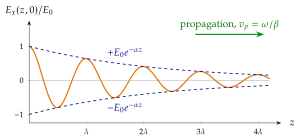
The wave still oscillates in space with the period and moves with , but its amplitude shrinks by the same factor over every distance . Everything the medium does to the wave is written in the two numbers and .
Figure 6.2.1 shows the field at one instant. The envelope is fixed in space, while the oscillation inside it moves to the right with . The attenuation is usually quoted in decibels. Since the field ratio over a distance is and ,
so a field decaying as loses per metre. The unit neper (Np) is the natural-logarithm counterpart of the decibel: a field ratio is , that is .
A field loses over one metre of a medium. What is , and what fraction of the field amplitude is left after one metre?
, and the amplitude ratio is , the same as .