Section 6.2 · Topic 2 of 9
6.2.2 The exact attenuation and phase constants
The square root in Eq. (6.2.6) can be taken once and for all. Square and compare it with from Eq. (6.2.4):
The real and the imaginary parts give two equations,
and a third follows from the modulus, :
Adding the first equation of Eq. (6.2.9) to Eq. (6.2.10) gives , subtracting it gives . Taking the positive roots ( for a wave that travels and decays along ) gives the exact constants.
The medium enters only through and the ratio .
Measure both constants in units of the lossless wave number and they depend on one number only, . A single pair of curves, Figure 6.2.2, therefore describes every medium at every frequency.
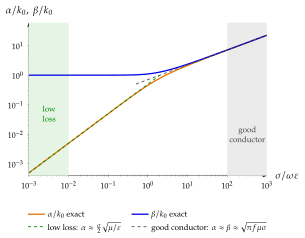
Two checks are worth making at once. For the bracket of vanishes and the bracket of is , so and , the lossless wave of Section 6.1. And whatever the medium, : losses always shorten the wavelength and slow the phase down, because the two equations of Eq. (6.2.9) force .
Reaching for because the medium "conducts", or for because it "is a dielectric". The class of a medium is decided by at the working frequency, not by its name. Wet soil at has (Home exercise 6.2.1) and brackish water at has exactly (Exercise 6.2.10): there the good-conductor formula is wrong and only Eq. (6.2.11) will do.