Section 6.2 · Topic 3 of 9
6.2.3 Intrinsic impedance and power flow
In the lossless medium the magnetic field of a plane wave travelling along is with (Section 6.1). Replacing by gives the complex intrinsic impedance of the lossy medium,
The angle follows from with , and since runs from to , runs from (a perfect dielectric) to (a perfect conductor). Two compact relations between and follow directly from Eq. (6.2.6) and Eq. (6.2.12), and they are often the fastest route in a problem:
Since has the angle , the first relation says that the angle of is , hence .
With the magnetic field is , and in the time domain
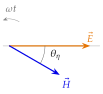
The magnetic field lags the electric field by . The time-average Poynting vector (Section 6.1) is
The fields decay as , the power density as , and lags by .
A lossy medium has an impedance with an angle: the magnetic field arrives a little later than the electric field, and the more the medium conducts, the later, up to an eighth of a period in a metal. The power falls twice as fast as the fields.
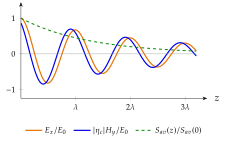
Where does the power go? In one attenuation length the field falls to and the power to . The power that leaves the beam heats the medium. With the identities of Eq. (6.2.13) one can show (Exercise 6.2.3) that at every depth
the time-average Joule power per unit volume of Section 4.2.7. This is Poynting's theorem for the plane wave: the power that disappears from the wave in a slab is exactly the heat produced in it. The proof uses only , whose real part gives , and the real part of , which then gives .
In a lossy medium the power density at the surface is . What is it one attenuation length deep, and what fraction of has been turned into heat on the way?
, so of the power has been absorbed in the first , although the field there is still of its surface value.