Section 4.2 · Topic 6 of 10
4.2.6 Ohm's law
So far the currents were given. We now ask what makes them flow. Consider a material of volume that is conducting. Let us suppose we have attached a generator with and terminals to this material and made the charges move (Figure 4.2.13). Then we observe a nonzero electric field in the conducting material, in contrast with the electrostatic conductor of Section 3.4, where because the charges had come to rest. Also, because of the constant motion of the charges, there is a current density .
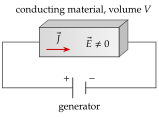
Naturally, this current density is proportional to the electric field: the charges are pushed by , and the collisions with the lattice give them a steady drift velocity proportional to the push. For most good conductors we can express this relation as
where is the conductivity of the medium, in siemens per metre [S/m]. Its reciprocal is the resistivity, in [m].
This is the point form of Ohm's law. The circuit form follows by integrating it over a conductor: for a wire of length and cross-section in which is uniform, , and
which Home exercise 4.2.4 evaluates for a copper wire and Exercise 4.2.5 for a radial current in a cylinder, where is not uniform and the integration must be done properly.
From now on we classify current densities into two kinds:
- the current density due to conductivity, , carried by the charges of a conductor drifting in a field, and
- the convection current density, , carried by charges that move freely, such as the electron beam of Application 3.1.4 in Section 3.1 or the charged droplets of an ink-jet printer,
In a conductor the current goes where the field pushes it, and says how willingly. Copper () needs only per metre to carry (Home exercise 4.2.4), whereas a heater wire of nichrome () needs to carry its current (Exercise 4.2.4).
Table 4.2.2. Conductivities at room temperature.
| Material | [S/m] | |
|---|---|---|
| Silver | contacts, plating | |
| Copper | wires, windings, tracks | |
| Aluminium | overhead lines, heat sinks | |
| Iron | cores (laminated against eddy currents) | |
| Nichrome | heating elements | |
| Sea water | ||
| Silicon (intrinsic) | ||
| Glass, polyethylene | to | insulators |
The same current density flows in a copper wire and in an aluminium wire. In which is the electric field larger, and by how much?
, so the field is larger in aluminium by the factor : in copper, in aluminium.