Section 4.2 · Further exercises · 8 of 10
Exercise 4.2.8: Energy in the gap of an electromagnet
About the further exercises of Section 4.2
Ten further exercises in the spirit of Problems 4.2.1–4.2.5, the worked examples and the home exercises, graded from easy to harder. Exercises 4.2.1–4.2.3 are about magnetic media and the boundary conditions, Exercises 4.2.4–4.2.5 about Ohm's law and the Joule phenomenon, Exercises 4.2.6–4.2.8 about inductance and energy, and Exercises 4.2.9–4.2.10 about dipoles and coupled circuits. They use only
As in the lectures, carries the units of (tesla), so is the magnetisation in A/m.
Energy in the gap of an electromagnet
#cf. Worked example 4.2.1
A U-shaped iron core () carries a coil of turns with . Its two poles, each of area , face an iron bar across two air gaps of each. Neglect fringing. Find (a) in the gaps, (b) the energy stored in the gaps and in the iron, (c) the inductance of the coil, (d) the force with which the bar is attracted, and the mass it can lift.
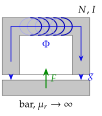
Ampère's law round the flux path: with the iron needs no at all, so the whole is spent across the two gaps. is continuous into the gaps (). Energy, and the force then follow from the gap field alone.
In the iron , so the whole magnetomotive force is spent in the two gaps, and is continuous across the pole faces:
Energy density in air . The two gaps have the volume :
The flux links all turns:
the same energy as in (b).
At constant current, a virtual displacement of the bar changes the stored energy, and the force is (the source supplies twice the mechanical work, exactly as in the capacitor case of Exercise 3.4.7):
that is per pole face. It lifts .
Units: is T/(H/m) J/m N/m, a pressure, and times an area a force. The force per unit pole area, , is the magnetic pressure: at , atmospheres at , about the limit for iron. The energy sits where is small, exactly as in the gapped toroid of Worked example 4.2.1. Closing the gap () sends and at constant , which is why the bar snaps shut.